

From the outside, Deutsche Bank looks like a classic financial institution – skyscrapers in Frankfurt, an international presence, and over 150 years of history. But a closer look reveals on of Europe’s most radical tech companies that underwent a digital transformation in record time.
Since 2019, the share of internal tech employees has grown from 30% to 80%. Today, 19,000 people work in technical roles at Deutsche Bank. Now, the company develops its software in-house, relies heavily on cloud infrastructure, and makes AI fluency a core competency for all employees.
The driving force behind this digital transformation is Bernd Leukert, Chief Technology, Data & Innovation Officer of Deutsche Bank, who joined the On Point. by ILI Digital Podcast in Karlsruhe. In conversation with Dr. Serhan Ili, CEO of ILI Digital, he spoke openly about engineering culture, the role of AI as a cultural force, his leadership approach, and why trust matters more than perfection.
Leukert’s Move from SAP to Deutsche Bank: A Matter of the Heart
For 25 years, Bernd Leukert shaped SAP as a DAX board member and a driving force in the software giant. In 2019, he took on a new role at Deutsche Bank.
Many asked Mr. Leukert why he was leaving SAP after so many years to join Deutsche Bank. His answer is clear: He is convinced that the banking business of the future is a digital business – whether retail, corporate, asset management, or investment banking. Because everything is now fundamentally technology-driven. And for him, the opportunity to help shape especially Deutsche Bank’s transformation was also a personal motivation.
But with a mission this large comes enormous responsibility. In such a role, every capability that supports this transformation is required. When asked whether the future CEO of a bank must be a tech expert, Mr. Leukert answered pragmatically: a solid understanding of technology is absolutely essential. A board member today doesn’t need to write code every day. He also doesn’t anymore. But he recommends having done it at some point in your career to genuinely understand and contribute to the technical aspects. He confirmed with a wink that he could still code today. Even not only visual basics.
From 30% to 80% Tech Employees: Europe’s Biggest Tech Transformation
When Mr. Leukert joined Deutsche Bank in 2019, only 30% of employees were in technical roles. Today, that number is 80%, reflecting a deliberate strategic decision. At the time, the bank was heavily focused on outsourcing, handing over activities to external providers, defining SLAs, and driving down costs.
After a few weeks on the leadership team, Leukert realized that this approach was not right. He believed that true transformation required in-house expertise rather than relying on external resources, so outsourcing was largely stopped and an engineering culture with genuine in-house capabilities was established.
He emphasized looking outward, seeing Deutsche Bank as part of a larger tech ecosystem. By fostering partnerships instead of treating others as vendors, both sides could win and adapt quickly. This mindset built today’s Deutsche Bank, with 80% technical roles and a rare engineering culture.
Generative AI: The Technology That Changes Everything
Dr. Serhan Ili asked Mr. Leukert, what technology recently still surprised him. His answer was clear:

“I admit, AI – especially generative AI – surprised me. I believe it is the technology that will most profoundly impact our professional and private lives.”
By now, we know that Generative AI is a great type of artificial intelligence that can create new content, such as text, images, code, or music, rather than just analyzing existing data. It emerged from advances in deep learning and transformer models, which can understand context and patterns across vast datasets. Today, tools like ChatGPT, DALL·E, and Codex showcase its potential to transform work, creativity, and everyday life.
Mr. Leukert already knew AI, or Generative AI, would be important, but Microsoft’s $10 billion investment in OpenAI and ChatGPT’s public launch – with the quality we see today – truly surprised him too.
This shows how generative AI is transforming digital business. Tools like ChatGPT, DALL·E, and Codex have already attracted attention from the world’s leading companies by reshaping workflows, boosting creativity, and driving efficiency. Even leaders like Mr. Leukert are surprised by its speed and impact, highlighting that embracing AI is essential for staying competitive.
Small Language Models: The Future of Efficiency
For some, the AI landscape may seem like a bubble, but distinguishing meaningful developments is crucial.
When Dr. Serhan Ili asked whether the AI world is just a bubble or here to stay, Mr. Leukert said it is driven by a gold-rush mentality and pressure to keep up. He emphasized that AI is likely to be a lasting force. The Internet was once underestimated but now dominates daily life. AI is expected to follow a similar path. No company today truly profits from the massive data center services required for AI. Even Microsoft and Google can sustain their AI ventures only because they have other profitable business lines.
The real risk lies with new cloud and AI factory providers raising capital without a profitable business model. A bubble could burst there – but AI itself will not disappear.
However, using AI further on , and at an increasingly larger and more complex scale, requires significant resources beyond just personnel. As already mentioned, data centers and energy consumption must also be taken into account. Mr. Leukert illustrates this with an example from a direct report, highlighting remarkable developments whose scale may not yet be widely recognized.
- At the beginning of 2025, OpenAI used about 0.2 gigawatts.
- By year-end, it’s expected to reach 2 gigawatts.
- Their eight-year plan foresees 250 gigawatts.
For comparison: Germany requires 37 gigawatts, the UK 57.
And this shows the scale. It’s not just about capital but also energy – a scarce resource – and talent to operate these AI factories.
Hence, Mr. Leukert advocates for smaller language models. He predicts we will see many specialized models tailored to specific use cases, based on the belief that large language models are not always necessary. This approach also allows human resources to be utilized more efficiently, as less complex models are easier for employees to integrate and work with.
AI Fluency: When Employees Embrace AI
An another big surprise for Mr. Leukert during his time at Deutsche Bank, as the digital transformation progressed internally, was the employees’ response to AI. He says he was genuinely impressed – and pleasantly surprised – by the motivation and enthusiasm employees showed. “At the first workshop, everyone wanted to join immediately.”
Despite concerns that AI might threaten their jobs, employees approached the technology with curiosity and a willingness to learn, using it to drive change both externally and internally. This openness reflects AI Fluency in action, showing that employees not only understand AI tools but can apply them effectively drive this change confidently and together. It also lays the foundation for a structured approach to AI across the company, turning individual competence into organizational impact.
Three Pillars of AI Integration
Mr. Leukert points out that, despite this curiosity about AI and digital developments, there is still a risk of a “Wild West” dynamic where structure is lost. For this reason and to ensure that AI adoption delivers real value rather than chaos, Deutsche Bank developed a framework built around three pillars of AI integration. These pillars guide how the bank leverages AI to enhance work, optimize processes, and fundamentally transform operations. Based on Mr. Leukert’s insights, ILI Digital interprets the following three courses of action.
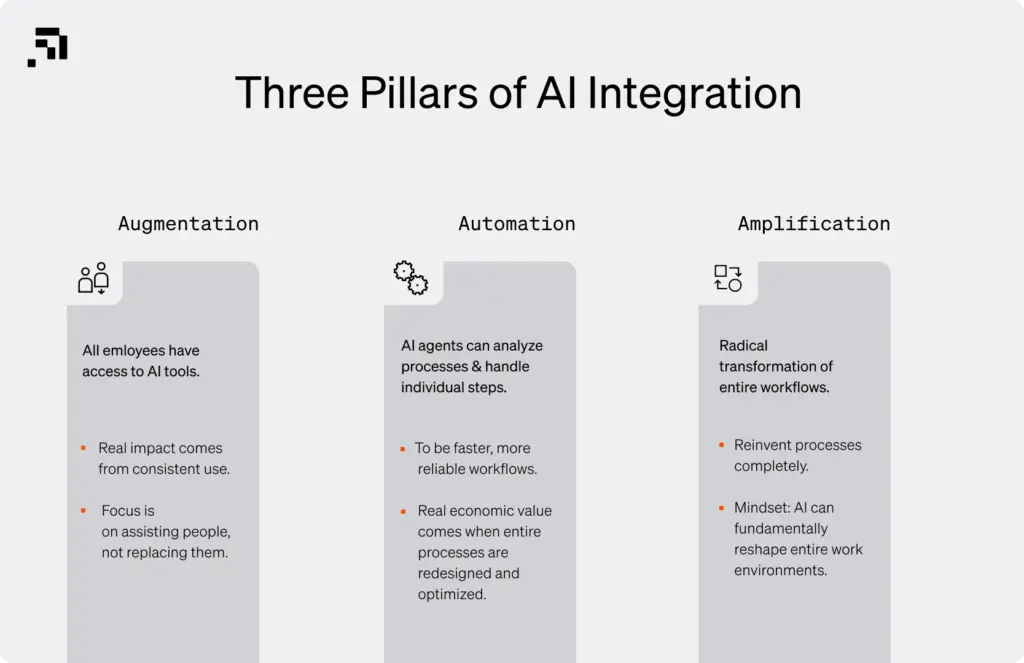
The first pillar, Augmentation, is about giving employees access to AI tools to support their work. While this alone does not create a full transformation, it allows employees to perform tasks more efficiently, increasing productivity by 10–20%. It also empowers teams to use insights from AI for better decision-making, whether that means reducing overwork or reallocating resources.
The second pillar, Automation, focuses on letting AI handle specific process steps. This speeds up workflows and improves reliability. The true economic benefit, however, comes when entire processes are redesigned, allowing the bank to achieve efficiency and accuracy on a scale that was previously impossible.
The third pillar, Amplification, goes beyond efficiency, it is about re-engineering entire processes. Mr. Leukert likens this to societal transformations like the introduction of GPS in mobility. Just as drivers began to trust data-driven guidance instead of relying solely on intuition, companies can now rely on AI to guide decisions, creating new ways to achieve the same goals more effectively. In banking, this means the institution still grants loans and advises clients, but the analysis, risk evaluation, and decision-making processes have been fundamentally transformed. Tasks remain the same, but the approach is entirely redesigned.
This approach opens up further opportunities. Employees gain time that can be devoted to innovation, developing new financial services, and focusing more on client engagement rather than internal processes. There is also a demographic dimension: as societies age, sustaining economic growth with fewer employees will be a challenge, and AI provides a pathway to maintain productivity and growth even with leaner teams.
Leadership: The Team with the Strongest Spirit Wins
A stable and confident leadership approach is essential to successfully navigate AI-driven change – and this is exactly how Mr. Leukert leads. His style is team-oriented, transparent, and human, yet firmly focused on results.
When he joined Deutsche Bank, the tech division scored poorly in employee surveys. “I said: I won’t accept that. We are technology – I want us at the top. And today, we are there,” he recalls.
For success, companies need individuals willing to go the extra mile and support each other whenever gaps appear, reflecting his belief that strong teams drive meaningful transformation.
The Two-Jersey Story – An anecdote from Bernd Leukert
Mr. Leukert’s leadership style became particularly evident through one of his examples and anecdotes. Some time ago, in an important leadership meeting where two sides had long behaved more like opponents than a team, Mr. Leukert used a simple but memorable gesture to set the tone: he brought two football jerseys. He explained that this would be the last time they entered a room wearing different jerseys – from now on, everyone would wear the same “team jersey” of Deutsche Bank.
The message was clear: success depends not on individual talent alone, but on shared strategy and collective spirit, much like in amateur football, where Mr. Leukert had been active and successful in previous years. From that period, he gained many insights and continues to translate his football experiences into his way of leading and working.
He also emphasizes the importance of trust within teams. A medium performance combined with high trust can be more valuable than high performance with low trust. In practice, this principle has also guided structural changes at Deutsche Bank.
Just like in football: he doesn’t care if someone scores a spectacular goal using an ultimate trick but then lets in four goals on the other side. What matters far more is that a person understands where they are needed and commits to supporting the team rather than going solo.
“I’d rather win 1–0 than lose 4–5. (…) We can afford to lose a match every now and then, as long as we win the championship as a team.” – Bernd Leukert
That’s why each service at Deutsche Bank now has a single owner, eliminating redundancy and fostering accountability. Trust is a key factor in reducing complexity and enabling efficient, effective work. And with that, the path to success will also become easier.
The Path to a DAX Board Seat: Principles, Not Secrets
When Dr. Serhan asked Mr. Leukert about the “secret” to becoming a DAX board member, Mr. Leukert is clear: there is no secret formula, no guaranteed plan. Instead, success follows a few guiding principles.
First, one must seize opportunities and be willing to invest more effort than others. Early effort is rarely immediately rewarded, but consistently taking on challenges and pairing talent with dedication gradually leads to bigger responsibilities.
Second, taking risks is essential. Avoiding risk can still lead to a successful career, but it won’t lead to a DAX board seat. Growth comes from stepping up, mastering tasks with your team, and learning along the way.
Third, timing and luck play a role. Being in the right place, at the right time, and recognized by the right people can open doors that hard work alone cannot.
A DAX board member is part entrepreneur, part politician: highly visible, always “on camera,” and needing to nurture networks both inside and outside the company. Yet, despite these demands, performance remains the ultimate measure. As Leukert puts it, it is the combination of preparation, courage, and execution that opens the path to leadership at the top.
Outlook 2026: Family, Growth, and Transformation
On a personal level, Mr. Leukert looks forward to spending quality time with his family, a chance to recharge and reflect on the year past. For Deutsche Bank, the focus is on growth opportunities both at home and abroad. With a clear strategy and a global perspective, the bank aims to expand its reach and continue delivering value to clients, even amid geopolitical tensions.
Looking at Germany, Mr. Leukert expresses cautious optimism. He hopes that the recent willingness to embrace change will translate into bold decisions that leverage the country’s strengths.
“We have enormous possibilities,” he notes. “We just need to seize them.”
Deutsche Bank’s transformation demonstrates that even traditional institutions can reinvent themselves when leadership, culture, and technology align.
Mr. Leukert’s key message: technology is teamwork, and trust beats perfection.
The bank is no longer just a financial institution doing IT on the side, it has become a tech company delivering banking services. This shift is more than semantic; it lays the foundation for the next years of growth and innovation.

Subscribe to our On Point. Channels
Go ahead and listen to the full episode now!