
The digital business landscape in Germany is entering a phase of accelerated transformation. Artificial Intelligence (AI) and Machine Learning (ML) have evolved beyond innovation projects. They are now shaping operational processes, strategic decision-making, and the competitiveness of organizations. While in 2024 only about one in five companies leveraged AI technologies, the share has recently risen to over a third, among large enterprises, it is almost half. Organizations that hesitate now risk falling behind the dynamics of the market.
AI as a Productivity Engine for your business
The impact of AI is clearly noticeable. Companies report productivity gains through generative AI, often in the double-digit percentage range. Forecasts, such as those from Bank of Dallas suggest that AI could boost annual productivity growth by 0.3 percentage points for the next decade.
Investment in AI continues to grow at pace. The German market is expected to reach new milestones in the multi-billion euro range by the next year, underlining the economic significance of AI for Germany as a business location
The German government supported already the development of AI with more than over 1.6 billion euros in funding until 2025, strengthening both the labor market and the innovative capacity of companies.
AI is no longer a future topic, it has become an integral part of everyday business operations. Germany ranks among the leading countries worldwide in employee access to generative AI tools, reflecting the rapid adoption and growing professionalization of AI use.
Given these developments and the underlying data, AI is now a strategic imperative. The relevant question for the German Mittelstand is not whether, but how to leverage digital and AI-driven business models in 2026 and beyond.
AI in Practice – Use Cases and Added Value in Digital Business
AI has become established in core business areas. AI-powered CRM systems now analyze customer interactions, predict churn risks, and identify cross-selling opportunities. Companies deploying AI in sales and marketing report more precise forecasts and stronger customer retention. Notably, 15 percent of companies already use AI intensively in these domains, with a clear upward trend.
Use Cases of AI Across Industries
In digital marketing, AI is transforming programmatic advertising, content personalization, and targeting. Solutions such as Google Ads and Adobe Sensei enable deeper insights and greater precision in campaign management, leading to measurable improvements in ROI.
Did you know: The most common areas of AI application are IT and Marketing/Sales.
In e-commerce, AI-based recommendation systems, chatbots, and intelligent logistics solutions are now standard. Companies like Amazon and Zalando set benchmarks in personalization and automation. Automated warehousing and individualized shopping experiences have become decisive competitive factors.
Cybersecurity is also benefiting: AI-driven solutions detect threats early, analyze patterns, and respond in real time. This is an essential capability given increasingly sophisticated cyberattacks. In industry, predictive maintenance, quality control, and supply chain optimization are making factories more intelligent and efficient.

A notable example of successful transformation is Deutsche Bank: Within five years, the share of tech employees increased to around 80%, a remarkable achievement for a company with legacy structures. In our latest On Point. Podcast, we discuss how Deutsche Bank has evolved into a technology leader, leveraging digital processes and artificial intelligence across fraud detection, risk management, and back-office automation.
These examples show that sustained investment in technology, the development of digital skills, and targeted support for tech talent are crucial drivers of cultural change. Even established organizations can secure lasting competitive advantages through these efforts.
At ILI Digital, we witness these developments first-hand, not only internally, but also as partners in innovation projects across the financial sector and beyond.
Statistical Fact: Since 2025 there have been around 3,568 new startups in Germany, most in the software sector (approx. 853). 29% of all startups use AI as part of their business model.
Future Trends – AI Agents and New Business Models
A particularly dynamic trend is the rise of AI Agents, autonomous, intelligent software that can independently perform tasks, make decisions, and interact with other systems. Interest in AI Agents among German executives is above average. These agents are not simply automating processes; they are redefining them, for example in customer service, supply chain management, or cybersecurity. AI Agents enable a new quality of automation and open the door to innovative business models, such as the integration of generative AI into research, development, and customer service.
AI as a Challenge: Implementation, Acceptance, and Quality
Despite these advances, the introduction of AI is not without challenges.
Organizations must address concerns regarding the tangible benefits of AI, the need for employee training, integration into existing systems, and the quality of results.
The following research results highlight the main points of skepticism:
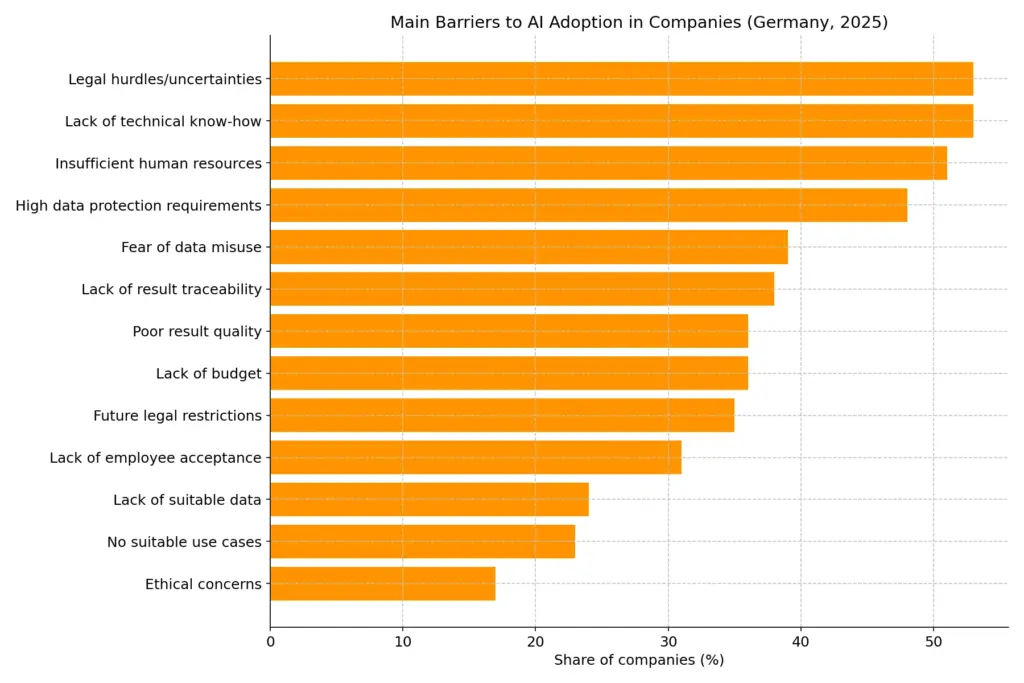
53 percent cite legal hurdles and uncertainties as the biggest obstacle, while an equal 53 percent mention a lack of technical in-house know-how. Another 51 percent complain about insufficient human resources, and 48 percent see the high requirements of data protection as problematic. Additionally, 39 percent of companies fear that data could fall into the wrong hands, and 38 percent criticize the lack of traceability of AI results.
Additional factors
In addition to these major barriers, there are also other factors that play a role, such as…
- the poor result quality and insufficient budgets for AI projects are each cited by 36 percent of companies.
- future legal restrictions, mentioned by 35 percent,
- a lack of acceptance among employees, cited by 31 percent,
- suitable data is missing,
- no appropriate use cases, and raising ethical concerns.
Data protection and ethics are particularly relevant in Germany. Employee acceptance depends largely on the transparent and responsible implementation of AI.
A significant proportion of companies still view legal restrictions as a barrier, while others report insufficient acceptance within their teams.
The key challenge is building trust between employees and AI.
ILI’s Recommendations – Take the Right Steps Now
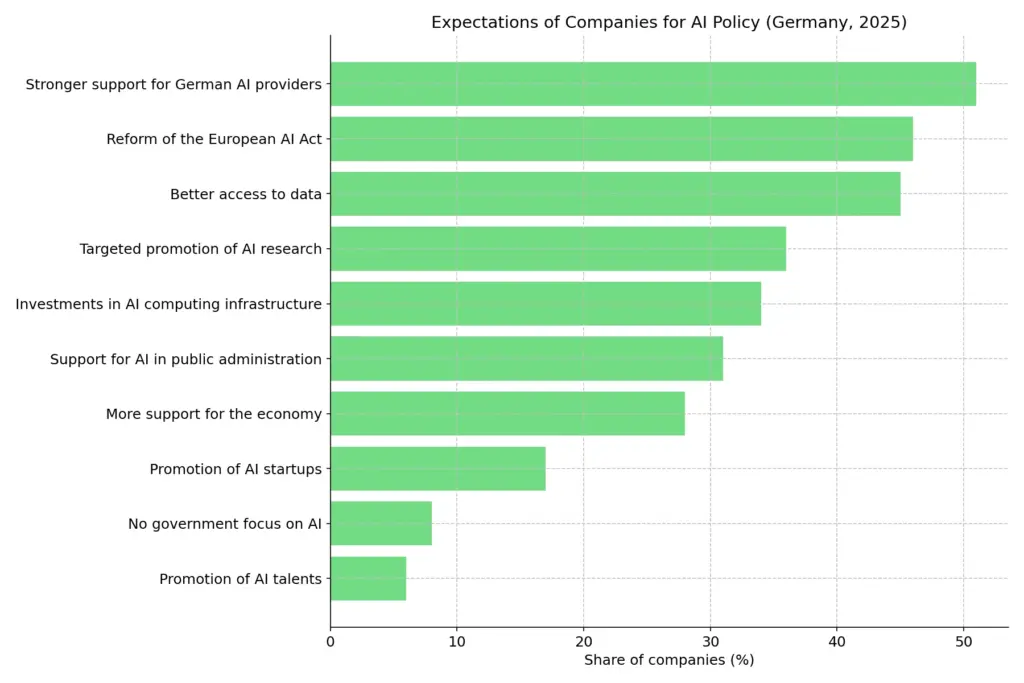
Despite prevailing skepticism, there is a clear, positive outlook. Especially among organizations that have already experienced the benefits of AI. Based on our research, companies in Germany expect future AI policies to focus on practical support, legal clarity, and the strengthening of digital competencies.
We are convinced: 2026 will be the year in which AI becomes established not merely as a tool, but as a strategic partner in business. AI Agents and autonomous systems are moving into focus, enabling a new quality of automation and opening up innovative business models.
For you as a decision-maker
It’s time to sharpen your own AI strategy now! Start targeted pilot projects and expand data competence within your company. Building know-how and close cooperation with startups and universities are just as crucial as developing clear governance for responsible AI use.
Therefore, these are our recommendations for the start of the year:
- Develop an AI strategy: Define your AI agenda and identify processes with real added value.
- Start pilot projects: Start small, learn quickly, and scale successes.
- Promote and attract talent: Invest in further training, build AI teams, and cooperate with external partners.
- Strengthen data competence: Ensure data quality, establish governance, and break down data silos.
- Live ethics and responsibility: Use AI transparently and fairly, involve stakeholders, and promote social acceptance.
Conclusion: Shaping the Future Business Actively
2026 marks a pivotal moment for digital business in Germany. Organizations that now anchor AI and AI Agents strategically will shape the standards of their industries and secure sustainable success. It is no longer sufficient to simply participate in digital transformation; leadership and vision are required.
The opportunities are considerable: Those who combine innovation, adaptability, and responsible use of technology will not merely accompany the digital transformation, they will actively shape it. True leadership means formulating a clear vision, inspiring teams, and driving change with expertise and integrity.
We are entering a period in which AI and autonomous systems will become strategic partners. Companies that invest in technology, foster talent, and set ethical standards will lay the foundation for sustainable growth and secure a decisive competitive edge.
Ready to lead with AI?
Book a consultation with our experts and unlock your company’s potential. Shape the future of your company, with AI as the engine for innovation, efficiency, and new business models.
The future starts with your decision – act now!

About ILI Digital
ILI Digital specializes in AI strategy consulting for enterprise clients, helping organizations move from experimental AI projects to strategic business transformation.
Connect with Our Team
- Follow our insights: ILI Digital Blog
- Schedule a consultation: Contact us
- Download our complete AI Strategy Framework Booklet